
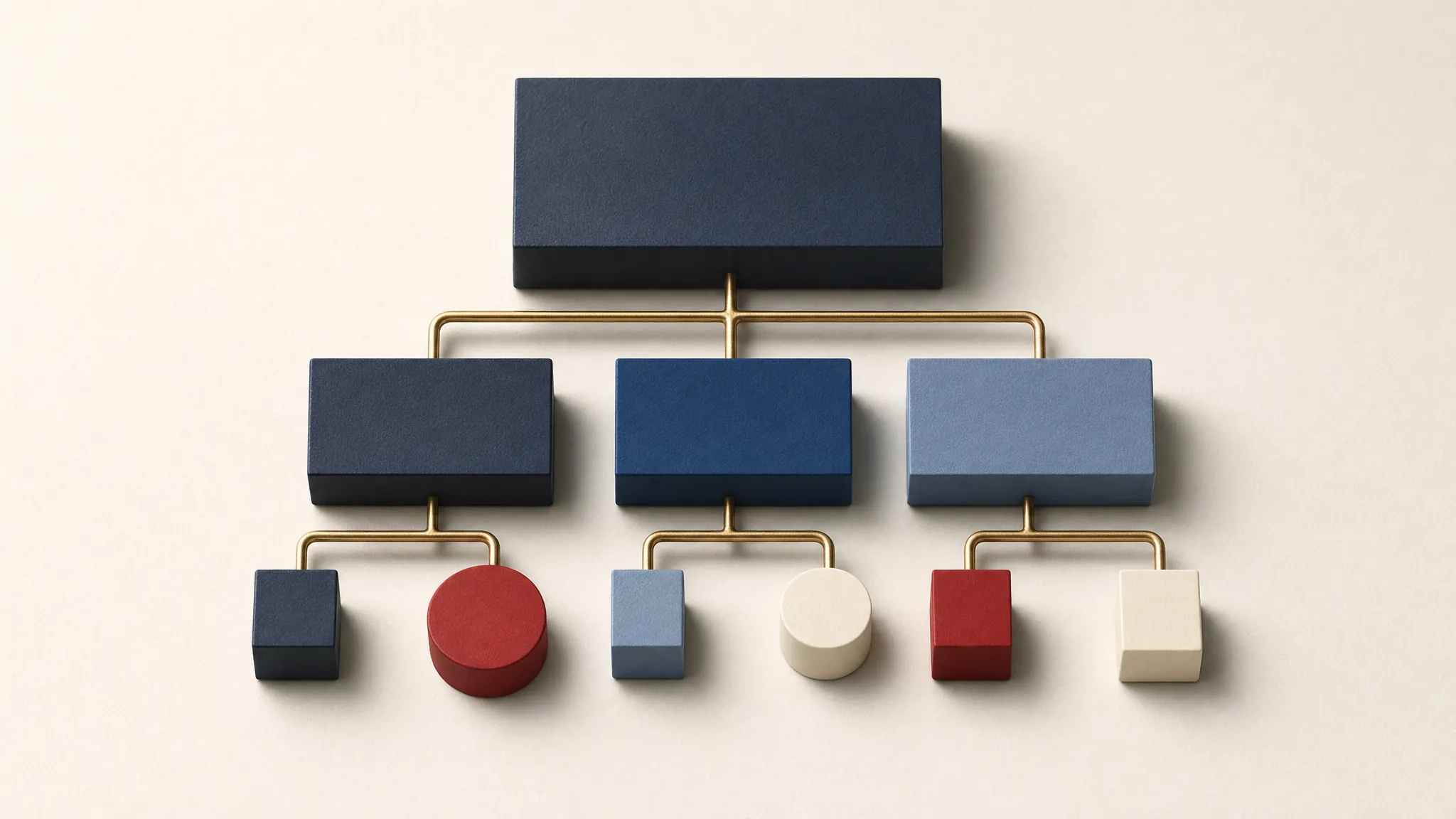
Brand hierarchy is the order that tells customers what matters first. It decides whether the parent company leads, whether a sub-brand carries the decision, whether a product line needs its own meaning, and whether a descriptor should quietly explain the choice. Done well, it makes a portfolio easier to understand. Done badly, it turns a simple buying moment into a family tree nobody asked to study.
The term often gets treated as a branding-department diagram, but the real test is much simpler: can a customer understand what they are looking at without a guided tour? The Branded Agency defines brand hierarchy as the set of brand names and related products or services, organized by their relationship to one another: its brand hierarchy guide. That structure only earns its keep when it reduces confusion in real buying situations.
kgb has built and backed brands where hierarchy had to be practical, not decorative: 118 118, 118 218, 1818, 118 118 Money, Conduit Global, and Dispo. Those brands did not all need the same public role. Some needed to be remembered as standalone consumer names. Some benefited from a wider operating story. The hierarchy has to follow the way customers choose, not the way a company prefers to draw itself.

Start with the customer's path through the offer
A useful hierarchy starts by mapping what the customer needs to know first, second, and third. Do they need the parent company for reassurance? Do they need the product name because that is what solves the immediate problem? Do they need a category descriptor because the offer is unfamiliar? The right answer depends on the buying moment.
For a simple company with one strong offer, the hierarchy can stay tight: parent brand, product, proof, action. For a portfolio business, the job is harder. A visitor may need to understand the parent company, the operating philosophy, the portfolio, and the individual brands without getting lost. That is why hierarchy shows up in navigation, page titles, packaging, sales decks, public-facing pages, investor materials, and customer service language.
Design Bridge describes brand architecture as the framework used to structure and communicate relationships between brands, products, and services, with the goal of helping customers navigate offerings and make the right purchasing choices: Design Bridge on brand architecture. Brand hierarchy is where that strategic framework becomes visible in the details people actually see.
Know the levels before you move the names around
Most brand hierarchies include several possible levels: corporate brand, master brand, family or endorsed brand, individual brand, product line, product modifier, and descriptor. Not every company needs every layer. In fact, most should fight hard to avoid unnecessary layers because every extra name asks the customer to remember more.
A corporate brand tells people who owns or operates the system. A master brand leads the commercial promise. A sub-brand or endorsed brand adds a sharper role beneath the parent. An individual brand may stand mostly on its own. Product modifiers and descriptors help people distinguish versions without pretending every variation deserves a full brand.
| Hierarchy level | What it should do | Common mistake |
|---|---|---|
| Parent brand | Transfer trust and explain the wider operating promise. | Forcing the parent forward when customers need the product first. |
| Sub-brand | Signal a distinct audience, offer, or market role. | Creating a new name for internal excitement rather than customer clarity. |
| Product line | Help customers compare related options quickly. | Letting product names compete with the main brand for attention. |
| Modifier | Explain version, tier, format, geography, or use case. | Turning every small difference into a capital-B Brand. |
| Descriptor | Clarify the category when the name alone is not enough. | Leaving customers to decode what the offer actually is. |
Make the parent brand visible only when it helps
Parent brands are powerful when they reduce risk. They can tell a buyer, investor, partner, or recruit that the offer is backed by real experience, standards, capital, or operating discipline. Frontify notes that brand architecture helps companies manage a portfolio and communicate relationships clearly to customers: Frontify on brand architecture. That clarity is the parent brand's job when its reputation helps the decision.
The parent should not appear just because the company is proud of itself. If the parent name adds no trust, no understanding, and no useful signal, it may be visual clutter. Customers are rarely trying to reward the org chart. They are trying to solve a problem, reduce a risk, or choose between options that already feel too similar.
A good test is simple: if the parent brand disappears from this page, package, pitch, or product name, does the customer lose confidence or clarity? If yes, bring the parent forward. If no, let the offer do the work. Hierarchy should create confidence, not corporate self-portraiture.
Use sub-brands only when they earn memory
A sub-brand should have a job the parent cannot do cleanly on its own. It might serve a different audience, a different category, a different price tier, a different geography, or a different risk profile. If the sub-brand does not change how customers understand or choose the offer, it may simply be an expensive extra name.
This is where brand hierarchy connects to brand portfolio strategy. A portfolio can contain many brands, but only some deserve independent investment. A separate name needs assets, consistency, customer demand, service habits, and enough repetition to become remembered. Without that support, the hierarchy looks impressive internally and weak in the market.
Sub-brands also need boundaries. If a sub-brand stretches until it means everything the parent means, the hierarchy becomes redundant. If it becomes too detached, the parent cannot transfer trust. The practical middle is to decide what each name owns: audience, promise, use case, geography, standard, or product role.
Do not confuse hierarchy with architecture
Brand architecture is the strategic relationship model. Brand hierarchy is the visible ordering system. A company might choose a branded house, a house of brands, an endorsed system, or a hybrid structure; the hierarchy then decides how those relationships appear in names, pages, packaging, product menus, and proof points.
That distinction matters because teams often try to fix a strategic problem with cosmetic ordering. Moving logos around will not solve overlapping brands, unclear promises, weak product roles, or unfunded sub-brands. The related guide to branded house vs house of brands goes deeper on choosing the model before polishing the display.
The reverse is also true. A smart architecture can still fail if the hierarchy is clumsy. If the website navigation buries the most useful brand, if sales decks introduce three names before explaining the problem, or if a product page makes the descriptor more visible than the brand, the strategy will feel harder than it is.
Watch for hierarchy problems customers can feel
Brand hierarchy problems usually show up as small moments of friction. Customers ask whether two offers are the same. Sales teams explain the company differently. Product pages compete with parent pages. Support teams hear customers using the wrong names. New launches want their own brands because the existing system has no clear place for them.
Another warning sign is modifier inflation. A modifier should help people compare versions: pro, plus, business, studio, local, premium, money, mobile, or whatever the category naturally understands. When modifiers become vague badges, they stop clarifying and start decorating. A hierarchy is not stronger because every name got an adjective.
Governance matters here. Frontify defines brand governance as the work of controlling how a brand is presented and used internally and publicly, including guidelines, assets, workflows, and training: Frontify on brand governance. In plain terms, people need rules they can actually use. If every team invents its own hierarchy, customers inherit the mess.
Build a hierarchy customers can repeat
A strong hierarchy should be explainable in one or two sentences. For example: this is the parent company, these are the brands it has built or backed, this brand serves this market, and this product line solves this problem. If that sounds too simple, good. Customers do not buy extra complexity just because the internal history was complicated.
On a website, hierarchy should appear in the path a visitor naturally follows. kgb's own site gives visitors several proof routes: the company story, the operating philosophy, the portfolio, and the 118 118 campaign archive. Those routes let the parent story and the individual brand proof support each other without pretending they are the same thing.
The same discipline should guide product names, page titles, navigation labels, case studies, pitch decks, and partner materials. Put the most decision-useful name first. Use descriptors when they remove doubt. Keep proof close to the brand role it supports. Remove layers that only make the company feel bigger.
How kgb thinks about brand hierarchy
kgb's bias is that every name should earn its place in customer memory. A parent brand should come forward when it adds trust. A sub-brand should stand apart when it makes choice clearer. A product line should explain the difference customers actually care about. A descriptor should clarify, then get out of the way.
That discipline is especially important for founders and operators building across multiple offers. The temptation is to name every initiative as if naming creates value. It does not. Value comes when customers can remember the right name in the right moment and trust what sits behind it.
If the hierarchy feels unclear, start with the buying path. What does the customer need to understand first? Which name carries the most trust? Which offer needs independence? Which descriptor removes friction? The right hierarchy is the one that answers those questions quickly enough for the customer to keep moving.
Brand hierarchy FAQ
What is brand hierarchy?
Brand hierarchy is the way a company organizes the relationship between its parent brand, sub-brands, product lines, services, and descriptors. A good hierarchy helps customers understand what they are looking at and how each offer connects to the wider company.
How is brand hierarchy different from brand architecture?
Brand architecture is the strategic model for how brands relate to each other. Brand hierarchy is the visible order customers and teams use to understand those relationships across names, pages, packaging, navigation, and sales conversations.
Why does brand hierarchy matter?
Brand hierarchy matters because unclear brand roles slow the customer down. When people cannot tell what the parent brand means, which product is right, or whether two offers are related, the company wastes trust and makes choice harder.
When should a company review its brand hierarchy?
Review brand hierarchy after an acquisition, new product launch, market expansion, rebrand, portfolio cleanup, or any moment when customers, sales teams, or partners start explaining the brand system in different ways.
Make the brand system easier to choose
See how kgb has built brands with distinct roles and real market memory.
View the portfolioRelated posts
Keep building the system
 Brand Purpose: Make the Promise Worth Believing
Define a brand purpose customers can feel in the product, experience, and proof instead of leaving it trapped in a values statement.
 Brand Governance: Keep the System Clear as You Grow
Build brand governance that gives teams clear decision rights, useful standards, and enough flexibility to keep customer memory intact.
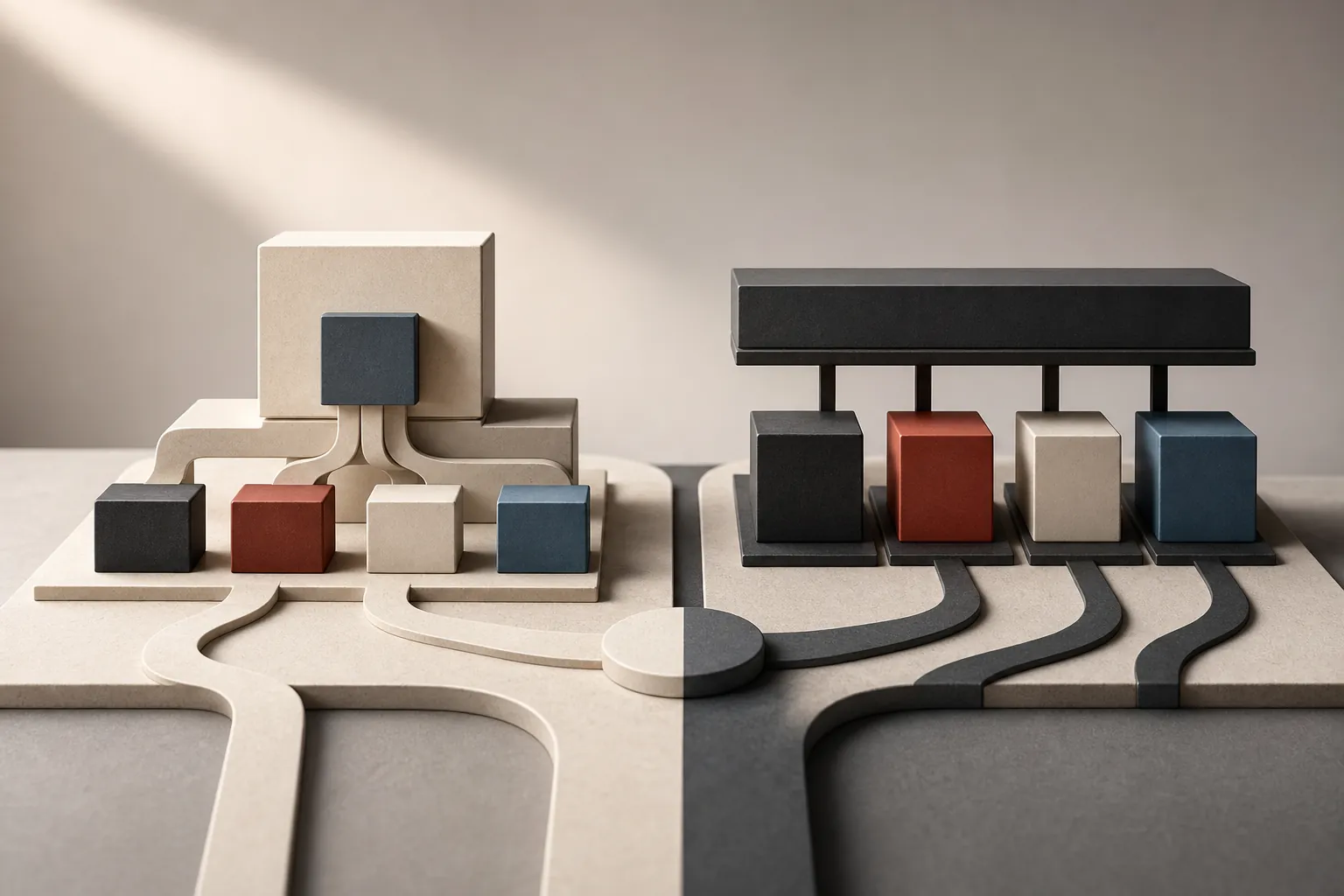 Branded House vs House of Brands: Choose the Right System
Compare branded house and house of brands models by customer clarity, trust transfer, risk, cost, and portfolio growth.